
An effective healthcare network is the IT infrastructure that keeps clinical and operational services reachable, responsive and diagnosable across hospitals, clinics, imaging centers, laboratories, remote sites, cloud services and vendor connections. A device can be up while Electronic Health Record (EHR) access, Picture Archiving and Communication System (PACS) retrieval, telehealth or a wireless clinical workflow is still slow or unavailable.
Effectiveness is how visible, resilient, measurable, prioritized, controlled and actionable a network is. The goal is faster understanding of what is affected, where the fault sits, who owns the next action and whether the response restores the workflow.
A practical operating sequence is:
- 1Discover devices and maintain current inventory.
- 2Map critical service dependencies across sites and providers.
- 3Design redundancy around real failure domains and observe backup paths.
- 4Baseline performance by service, site and time.
- 5Prioritize critical traffic, wireless infrastructure and capacity.
- 6Segment by function and risk, then validate traffic across boundaries.
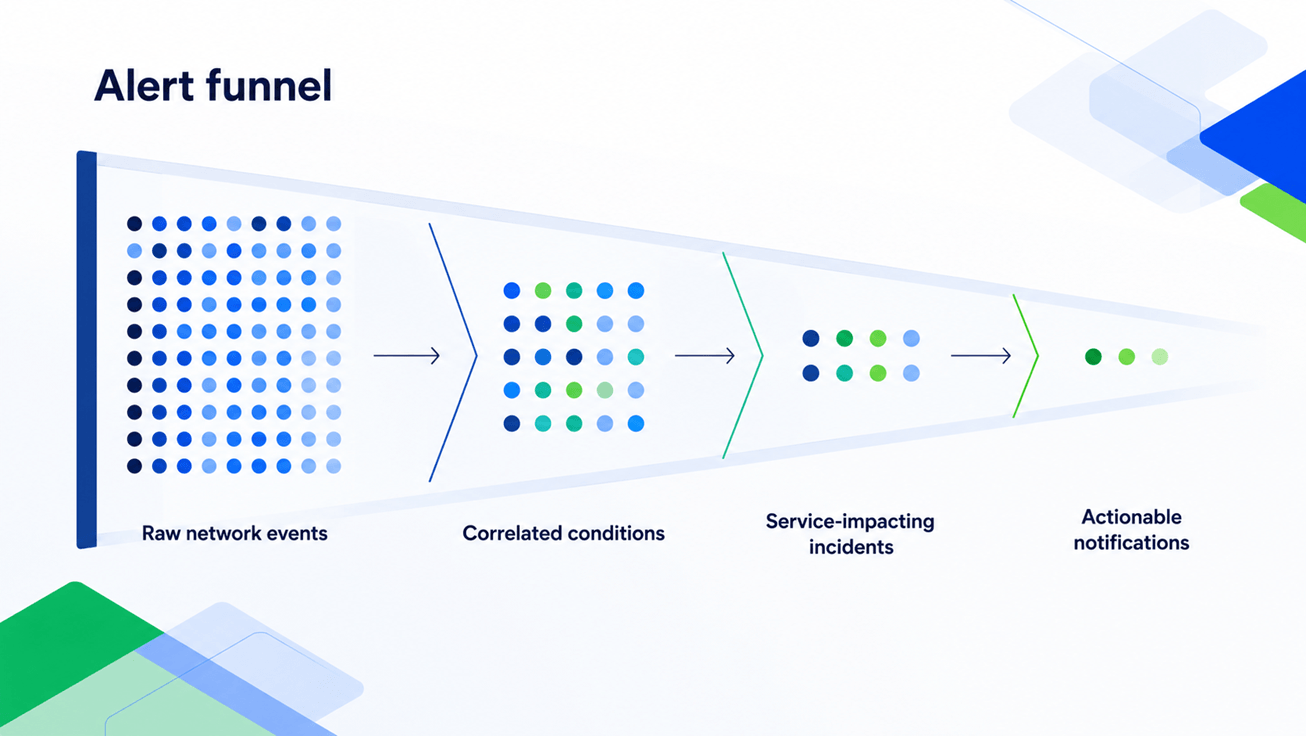
- 7Turn raw events into owned, actionable alerts.
- 8Monitor end-to-end paths, including carriers, cloud services and vendor links.
- 9Control change, test recovery and improve the monitoring program after incidents.
How Effective Healthcare Networks Work
Clinical Workflows Depend on More Than Device Uptime
A clinical service is a chain. EHR access may depend on identity, DNS, application servers, storage, databases, Wi-Fi, WAN paths and hosted services. PACS adds large image transfers; telehealth adds sensitivity to latency, jitter and packet loss. Monitoring must follow those dependencies, not stop at device status.
A device-only dashboard can mislead. A router answering ping proves reachability, not an acceptable application response. Experienced operators compare component health with path quality and service symptoms. NHS England healthcare guidance likewise emphasizes visibility across wired, wireless, third-party and cloud services.
Healthcare Networks Are Heterogeneous and Distributed
Healthcare networks combine mixed-vendor switches and firewalls with virtual hosts, cloud services, legacy servers, Wi-Fi, VPNs, vendor-managed equipment and networked medical or Internet of Medical Things (IoMT) devices. Hospitals, clinics, labs, imaging centers and remote practices add separate dependencies and failure domains that a single global status view can hide.
Availability, Performance, Resilience and Security Are Linked
A secure service that clinicians cannot reach is ineffective; a fast service with unknown devices or uncontrolled remote access is also ineffective. The HIPAA Security Rule requires appropriate administrative, physical and technical safeguards for the confidentiality, integrity and availability of ePHI. Monitoring supports visibility, activity review, evidence and risk management, but does not establish HIPAA compliance. HHS identifies the 2024 Security Rule update as proposed; the current rule remains in effect.
Discover and Map the Healthcare Network and Its Dependencies
Maintain a Current Inventory
Start with what is connected: routers, switches, firewalls, access points and controllers, servers, virtualization, key application and infrastructure services and supported endpoints. Treat discovery as a recurring process. A spreadsheet produced during an implementation project becomes stale as clinics add equipment, vendors replace devices, DHCP assignments move and virtual workloads change.
Inventory is also a security visibility issue. HHS voluntary Healthcare and Public Health Cybersecurity Performance Goals include asset inventory and call out known, shadow and unmanaged assets. That does not mean every medical device should be actively scanned. Respect device-vendor guidance, clinical engineering policy, fragile legacy equipment and patient-care windows.
Map Service Dependencies, Not Just Devices
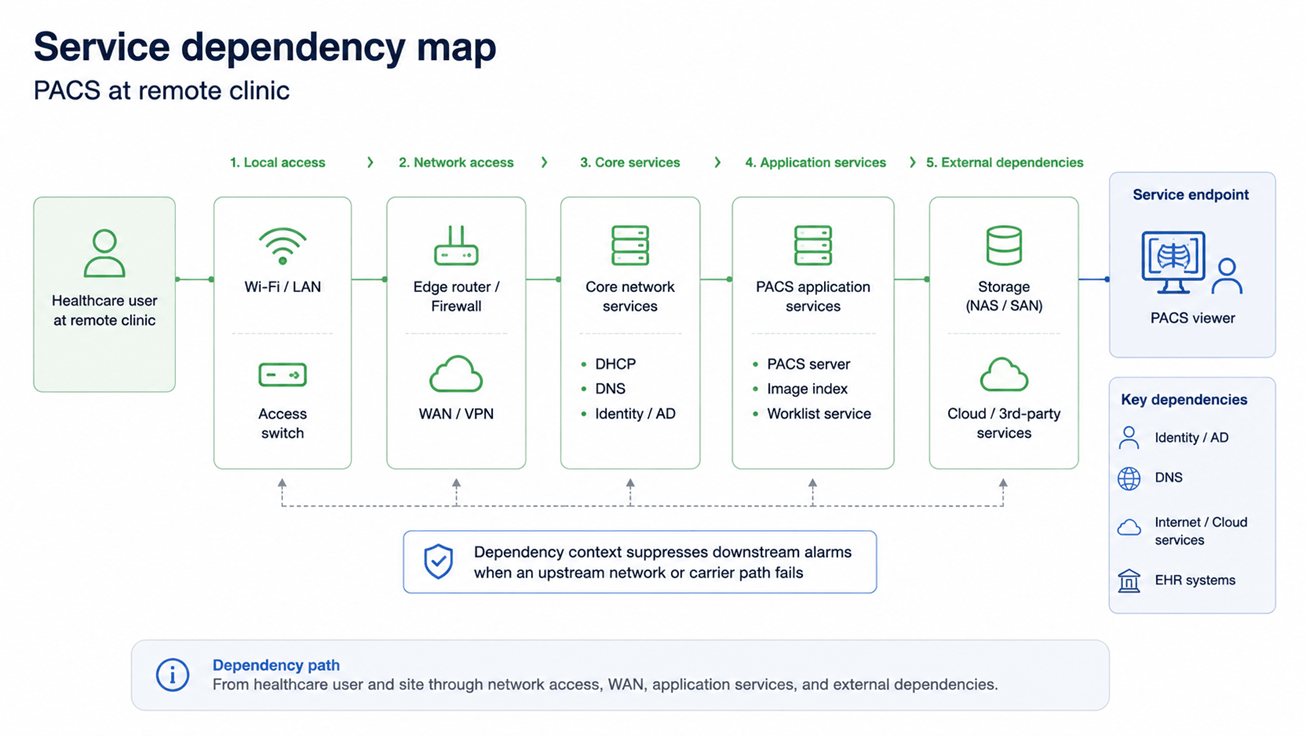
Network topology matters when it answers a service question. For PACS at a remote clinic, map the endpoint through local access, WAN or VPN, core services, application components, storage and external dependencies. For EHR login, include identity and DNS. Dependency context also helps suppress downstream alarms when an upstream router or carrier path fails.
Be Precise About Medical-Device Visibility
Network monitoring can show that a supported medical device is present, reachable, attached to a port or access point, consuming bandwidth or communicating with expected services. It does not prove clinical function, safety, calibration or valid biomedical telemetry. Keep those responsibilities with clinical engineering, device management and safety processes.
Design for Resilience and Redundancy
Identify Critical Failure Domains
Map single points of failure around clinical services rather than device counts. Core switching, WAN or internet access, DNS and DHCP, authentication, wireless controllers, virtualization, storage and application dependencies may interrupt care workflows. A small clinic with one carrier circuit may deserve higher remediation priority than a larger redundant site.
Monitor Redundant Paths and Backup Components
Redundancy can fail silently if nobody observes it. Monitor secondary links, standby devices, routing state, tunnels, controller pairs, power components and capacity headroom. Confirm that traffic moves to the alternate path and that the backup can carry clinical load; backup design alone does not prove backup readiness.
Exercise Failover and Downtime Procedures
Test failover on a schedule set by service criticality and risk. Capture a baseline, confirm the expected path or component transition, then compare response time, packet loss, service checks and user-visible behavior afterward. If the network fails over but the clinical service does not recover, the exercise exposes an unresolved dependency.
Establish Performance Baselines and Service-Oriented Thresholds
Define “Normal” by Site, Service and Time Period
Build baselines around the conditions that shape real clinical demand. Track interface utilization, latency, jitter, packet loss, errors and discards, device CPU and memory, availability and response times. Then compare those metrics by site, service and time period so teams can distinguish expected workload patterns from early signs of degradation.
- Shift changes and clinic hours
- Backups, patch windows and scheduled maintenance
- Large imaging transfers and PACS retrieval
- Cloud jobs, SaaS dependencies and other recurring background workloads
Use Thresholds That Reflect Service Impact
Avoid copying one threshold to every site and device. Set warning and critical levels around observed service behavior and use persistence so a brief spike does not page an engineer. NHS Health and Social Care Network Quality of Service guidance treats delay, jitter, bandwidth and packet loss as service-quality variables, which is more useful than one universal utilization percentage.
Trend Capacity, Not Just Incidents
Use history to spot capacity pressure before it becomes an incident. Trend WAN circuits, busy interfaces, wireless client density, storage and network paths and service dependencies. Apply the data when opening clinics, adding imaging workloads, moving services to SaaS or investigating recurring slow periods.
Monitoring metrics matrix
| Layer | Examples | Why It Matters |
|---|---|---|
| Device | CPU, memory, temperature and hardware state | Find resource or hardware stress |
| Interface | Utilization, errors, discards and link state | Find congestion or physical and link problems |
| Path Quality | Latency, jitter, packet loss and reachability | Connect network behavior to service experience |
| Traffic | Bandwidth, flows, top talkers and traffic shifts | Explain consumption and unusual patterns |
| Service | Availability, response time and dependencies | Measure whether critical workflows can function |
| Operations | Mean Time to Detect (MTTD), Mean Time to Resolution (MTTR), alert volume and repeated incidents | Measure monitoring and response effectiveness |
Prioritize Critical Clinical Traffic, Wireless and Capacity
Define Service Tiers
Set service tiers by clinical and operational impact, then use them to drive monitoring depth, alert severity, escalation and change protection. EHR, PACS, identity, DNS and DHCP, critical Wi-Fi, voice, telehealth, WAN and internet access often need tighter observation.
Treat Wireless as Core Clinical Infrastructure
Mobile workstations, barcode medication workflows, voice handsets, tablets and some connected devices make Wi-Fi part of the care path. Monitor controllers and access points, client density, capacity and radio indicators when available. A healthy wired uplink can coexist with roaming failures, oversubscription, weak signal or interference.
Manage QoS and Capacity Deliberately
Quality of Service (QoS) helps manage network contention, but it is not a substitute for adequate capacity. Use QoS when latency-sensitive traffic needs predictable handling and validate that markings, queues, packet loss and user experience behave as expected under load. If congestion rarely occurs, complex queuing may add unnecessary overhead. If congestion is frequent, QoS can protect selected traffic, but it cannot create additional bandwidth.
Segment by Function and Risk—Then Monitor the Boundaries
Separate Systems According to Purpose and Risk
Segment according to permitted communication and risk. Common boundaries include clinical or medical-device networks, corporate endpoints, guest access, administrative systems, critical shared services and vendor access. The design may combine VLANs, routing, firewalls, Network Access Control or microsegmentation. A small clinic and a multi-hospital system should not share one prescribed topology.
Use Segmentation to Reduce Blast Radius and Simplify Troubleshooting
Good segmentation narrows security and operational failure domains. It makes traffic paths explicit, limits unnecessary lateral reach and lets responders inspect a smaller set of policies and dependencies. HHS lists network segmentation as an enhanced voluntary healthcare cybersecurity goal, not as a prescribed VLAN architecture or standalone HIPAA requirement.
Monitor Inter-Segment Traffic and Access Paths
VLANs on a diagram do not prove segmentation is working. Validate observed flows and policy behavior. Where supported, use flow exports and additional telemetry to find unexpected inter-segment traffic, changed vendor access or bottlenecks at security boundaries. Review long-lived exceptions, broad legacy rules and shared services that create hidden cross-zone paths.
Make Alerts Actionable, Owned and Context-Rich
Reserve Paging for Conditions That Require Action
Use one test for every page-worthy alert: what should the responder do when it fires? If there is no expected action, route it to a dashboard, report, log workflow or ticket queue. NHS England guidance similarly emphasizes notifications with affected users, devices and application context.
Use Persistence, Dependencies, Severity and Maintenance Windows
Suppress child alarms when an upstream dependency is known to be down, separate warning from critical states and require persistence where a brief spike is harmless. Use maintenance windows for planned work. Revisit dependency logic after topology changes because stale dependencies can hide failures just as missing ones create noise.
Measure Alert Quality
Track repeated alerts, false positives, unowned notifications, MTTD, MTTR and incidents first reported by clinicians or help-desk callers. “Users found it first” points to a gap in coverage, thresholds, dependency modeling or escalation. Optimizations should focus on reliable detection of service-impacting conditions, not the lowest possible alert count.
Monitor End-to-End Paths Across Networks, Traffic and Services
Go Beyond Ping and Device Status
Troubleshoot from the symptoms outward. For slow PACS retrieval, check service response, storage and application paths, WAN latency and loss, interface errors and current traffic. For degraded telehealth, correlate timing with jitter, loss, WAN and ISP behavior, wireless health and endpoint location. Look for the layer that changed with the clinical symptom.
Use Traffic Analysis to Explain Congestion and Behavior
Flow export telemetry such as NetFlow and sFlow or IPFIX can show what is consuming a constrained path, which conversations shifted and whether pressure is site-specific. It is not packet capture, but it is efficient for top talkers, bandwidth attribution and historical investigation. Align retention and collection scope with privacy policy and monitoring capacity.
Include External Dependencies
Carriers, ISP paths, cloud services, SaaS, VPN gateways and vendor links may sit in the service path even when internal IT cannot configure them. Monitor enough of each boundary to locate degradation and identify the next owner. NHS England healthcare guidance explicitly includes third-party networks and cloud services in its visibility model.
Control Configuration and Change
Maintain Configuration Baselines and Backups
Keep recoverable versions of important network-device configurations and know which version is intended to run. Configuration monitoring should expose drift and unexpected change. NIST SP 800-53 Rev. 5 includes baseline configuration and configuration-change controls; healthcare IT departments can use that control model as a reference while applying their own regulatory and risk requirements.
Validate Planned Changes Before and After Deployment
Capture a pre-change service baseline, open a maintenance window, deploy in stages where feasible and compare post-change health with the baseline. Define rollback criteria before implementation, such as loss of site reachability, sustained packet loss, failed authentication or a critical service check that does not recover within the approved window.
Correlate Incidents With Recent Change
When a fault begins, recent changes should be visible context: configuration edits, firmware, routing, firewall policy, wireless changes, application releases, virtualization work and carrier maintenance. Correlation does not mean assuming every outage is self-inflicted. It means giving the responder a fast way to test a plausible cause and, when appropriate, restore a known-good state.
Build Response, Recovery and Continuous Improvement Around the Monitoring Data
Give Every Critical Condition an Owner and Runbook
A critical alert should state what happened, likely service impact, first owner, initial checks, escalation path and any fallback. Keep runbooks short enough to use under pressure. Current commands, dashboards, carrier contacts and a clear escalation point matter more during an incident than several pages of architecture history.
Test Downtime and Recovery Processes
Exercise communications, degraded workflows, failover and restoration at a cadence set by risk and policy. Use monitoring timestamps to reconstruct when the primary failed, failover began, dependent services recovered and users could work normally. HHS’s voluntary healthcare goals also include incident planning and configuration-management practices.
Review the Monitoring Program Regularly
Use post-incident review to improve monitoring. Ask which incidents users found first, which alerts were ignored, which dependencies were missing, where capacity is tightening and which sites are poorly instrumented. Standardize repeated troubleshooting steps when the evidence supports it.
What to Look for in Healthcare Network Monitoring Software
Evaluate network monitoring software against actual healthcare IT work, not the longest feature list. Look for discovery and topology mapping, device, interface, path and service monitoring, historical baselines and custom thresholds, traffic analysis, wireless and distributed-site visibility, dependency-aware alerts, maintenance windows, escalation, configuration and version visibility and useful reporting.
Test maintainability in the proof of concept. Model a real clinical service, simulate an upstream failure, test alert suppression, inspect history and confirm on-call staff can move from symptom to likely owner. NHS England recommends assessing network management functions against the existing infrastructure, licenses, technology mix and intended use.
Evaluate security-specific capabilities separately. Infrastructure monitoring can expose network, configuration, log and traffic data, but it does not replace identity controls, endpoint security, vulnerability management, SIEM and SOC processes or a security program. For Network Detection and Response (NDR) or similar features, verify licensing, data sources, response workflow and ownership between network and security operations.
How WhatsUp Gold Supports Healthcare Network Operations
WhatsUp Gold capabilities cover several practices above: Layer 2 and Layer 3 discovery and topology mapping, device dependencies, network, device, server and application monitoring, dashboards and alerts, historical reporting, wireless monitoring, configuration management, distributed monitoring for remote networks and flow telemetry including NetFlow, IPFIX, sFlow and J-Flow. Treat current product documentation, editions and licensing as the source of truth for feature availability.
Healthcare customer case studies illustrate the operational range:
- Calgary Foothills Primary Care Network describes unified visibility across seven locations. Hattiesburg Clinic describes infrastructure and external-connection monitoring across roughly 50 locations.
- Optim Healthcare describes EHR, PACS, Active Directory, SQL Server and application monitoring.
- CSAM Health describes infrastructure and application monitoring for critical eHealth services.
Infrastructure monitoring can help teams detect and investigate issues, but it does not establish HIPAA compliance, guarantee availability or validate medical-device clinical function.
Start a free WhatsUp Gold trial to map your environment, establish service baselines and test how quickly IT staff can move from an alert to the affected dependency and owner. For a broader overview, explore healthcare network monitoring solutions.
Frequently Asked Questions
What Is a Healthcare IT Network?
A healthcare IT network connects healthcare staff, facilities, servers, applications, cloud services, networked devices and external providers through wired and wireless access, switching, routing, WAN and internet connections, DNS and DHCP and identity-related paths. It is distinct from health-plan or provider-network administration.
What Should Healthcare Organizations Monitor on Their Networks?
Monitor device and interface health plus service context: utilization, errors, latency, jitter, packet loss, flow export data, wireless infrastructure, critical dependencies, configuration changes and external links. Match collection frequency to service criticality and monitoring capacity.
How Can Healthcare IT Teams Reduce Alert Fatigue?
Page only on conditions that require action. Use persistence, dependency suppression, warning and critical tiers, maintenance windows, explicit ownership and regular reviews. Alerts that are repeatedly ignored or closed without action should be redesigned, rerouted or removed.
Why Is Network Segmentation Important in Healthcare?
Segmentation limits unnecessary communication and creates smaller security and operational failure domains. It also clarifies policy between clinical devices, corporate endpoints, guest access, shared services and vendors. HHS includes segmentation in its voluntary healthcare Cybersecurity Performance Goals, not as a prescribed VLAN design or standalone HIPAA requirement.
Does Network Monitoring Make an Organization HIPAA Compliant?
No. Monitoring supports visibility, activity review, evidence, incident investigation and availability management. HIPAA Security Rule compliance is broader and includes administrative, physical and technical safeguards for ePHI. Use HHS guidance and organization-specific legal or compliance review.
How Often Should Healthcare Networks Be Monitored?
Monitor critical infrastructure and service health continuously, but vary collection intervals based on service criticality, failure speed, device limits, telemetry cost and monitoring capacity. Fast-changing service indicators need shorter intervals than inventory or slow capacity trends.
Conclusion
Effective healthcare networks are visible, resilient, measurable under load, controlled during change and tied to action. Follow a practical, repeatable sequence:
- Discover devices and maintain an accurate inventory.
- Map critical clinical services and their dependencies.
- Design for resilience around real failure domains.
- Baseline performance by service, site and time period.
- Prioritize critical traffic, wireless infrastructure and capacity.
- Segment systems by function and risk.
- Monitor devices, services, traffic and end-to-end paths.
- Alert the right owner with clear, actionable context.
- Recover by testing failover, escalation and restoration processes.
- Improve monitoring based on incidents and operational evidence.
Keep every step connected to the clinical services the network supports.
Start with one high-impact workflow, such as EHR access, PACS retrieval or a remote-clinic WAN path. Map its dependencies, identify failure domains, establish performance baselines, test alert ownership and exercise recovery. Then apply the same method across the wider environment.
Test this approach across your own healthcare network.
Start a Free Trial of WhatsUp Gold
Greg Collins
Product Marketing Manager | Progress Software Corporation
Greg Collins is the Product Marketing Manager for the Progress WhatsUp Gold. He’s an accomplished marketer with 7+ years in startups, enterprise software, and technical B2B marketing for global organizations.
